
Getting Started with Tech: Faculty and Staff
Activate NetID
Your NetID is established within 24 hours of your acceptance of employment, your graduate student department acceptance, or your undergraduate student status (~early May after all deposits are received).
To activate your NetID, please follow the steps below:
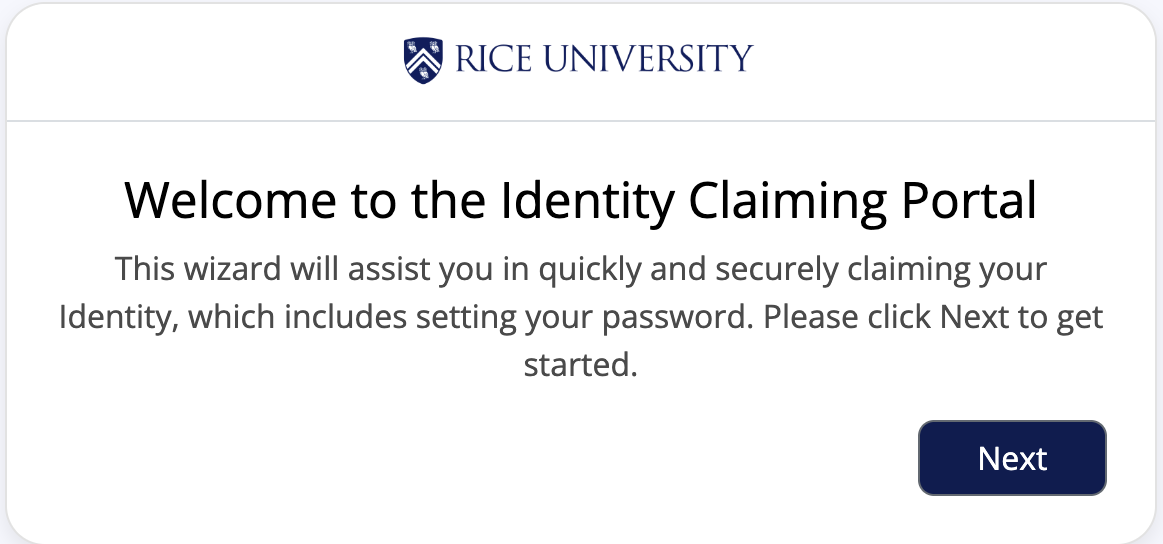
Go to the Online Account Management System, https://whooru.rice.edu/claim/initial. On the Identity Claim Portal screen, select Next.
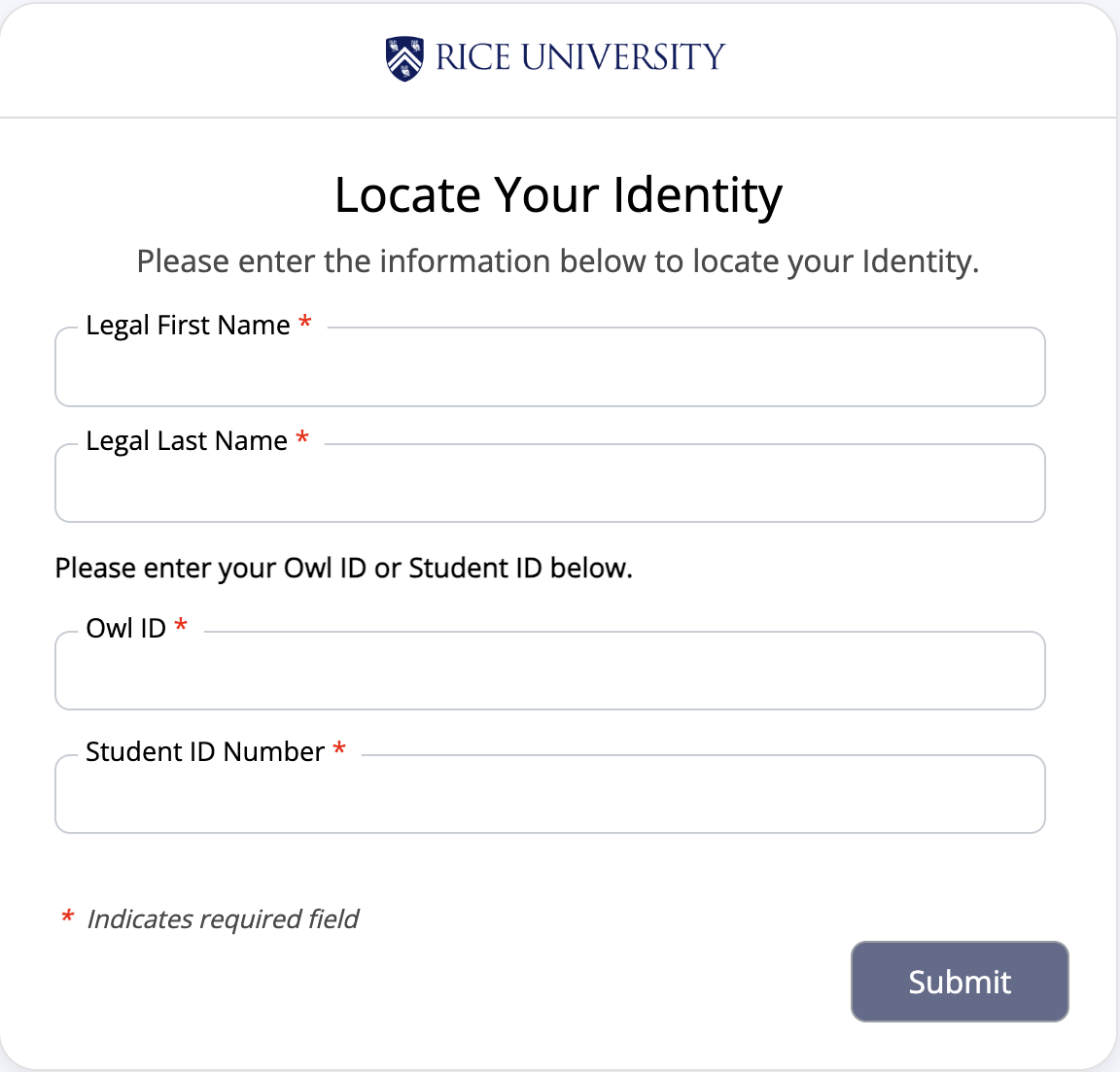
You'll be asked to give your legal first and last name, which should match the name given to the Office of the Registrar or Human Resources, and your Rice Owl ID or Rice ID number (provided in your welcome email). Then select Submit.
During your NetID account activation, you will be guided through the Duo Enrollment process to set up your multi-factor authentication (MFA) access methods. Please follow the on-screen prompts to continue.
NOTE: The NetID activation process can only be completed once, and an error message will appear if you have already activated your NetID.
Your NetID will be displayed on the page to set up your password. Please be sure to make a note of your NetID. In the example below, lt63 is the NetID.

After successfully setting up your NetID password, you will receive a message that your Identity Claim has been completed. You will be redirected to the login screen and prompted to sign in with your new credentials.
Once your account has been set up, you can access your Rice email through Rice Google Mail. To learn more, see here: Google Workspace for Education.
Need Help?
If you encounter any issues or need help activating your NetID, please contact the TS&S Service Desk.
How to reset a forgotten NetID Password
This section provides instructions for resetting a NetID account password.
If you have forgotten your NetID password and know your NetID, you are able to set a new password at WhooRU.rice.edu.
At the time you log in to WhooRU.rice.edu, you'll be prompted to sign in using Rice Single Sign On (SSO).
On the Rice Identity Provider page, select the Forgot your password hyperlink.

This will take you to the Password Reset Portal page.

When you’re ready to begin the password reset process, click Next. Enter your NetID, Legal Last Name, and then submit.

Verify your Identity by selecting one of the verification options listed on the screen. You can verify via email, text message, or by authenticating with Duo. After making your selection, a message on the screen will appear indicating that your request has been received, and instructions have been sent.
Follow the link provided in the instructions to Continue Forgot Password Process.
Enter your new password following the defined password requirements criteria, and re-enter the password again to confirm. Once completed, you'll be redirected to the WhooRU login screen and prompted to sign in with your newly set password.
If you need assistance throughout this process, please contact the TS&S Service Desk.
Duo for Authentication
This section is about Duo, an authentication service, also known as two-factor or multi-factor authentication (2FA or MFA), used for Rice systems that require an additional layer of security.
Authentication strengthens access security by requiring multiple methods (also called factors) to verify your identity. These factors can include something you know - like a username and password, plus something you have - like a smartphone app to approve authentication requests. Duo helps protect against phishing, social engineering, and password brute-force attacks and secures your accounts from attackers exploiting weak or stolen credentials.
[Doc 151761 content is unavailable at this time.]What is Duo?
Duo is the tool that Rice uses for multi-factor authentication (MFA). The purpose of this is to improve security and protect resources against unauthorized access or attempts to steal credentials and/or accounts.
How does Duo work?
Duo acts as an additional security layer for authorized individuals to access university systems.
In order to access a service, you must authenticate by providing at least two factors to validate who you are. This is done by sharing:
-
Something you know (e.g., username and password)
-
Something you have (e.g., smartphone or tablet)
In this way, you are required to prove your identity and also confirm that you are in possession of the device(s) that are needed to gain access to university resources. By doing this, you are helping protect Rice systems against cyber attacks.
Why is Duo important?
Hackers are constantly on the hunt for credentials to steal and accounts to exploit. Due to the increase in the number of these attacks, it is critical to ensure the safety and security of Rice’s data and systems. With Duo, we can ensure that critical university systems are only accessed by authorized users.
How to Enroll in Duo
At the time you activate your NetID account, you will automatically be taken through the Duo enrollment process. The NetID activation process can only be done once by an individual.
If you’ve been at Rice for a while and have never set up Duo, log in to WhooRU with your NetID and password to start the enrollment process.
Duo Authentication Methods
The authentication methods are how you will choose to authenticate your identity when accessing university resources. Please see the table below to review the methods that Rice currently supports in order of most to least secure.
| Authentication Method | Category | Security | Description |
|---|---|---|---|
| Platform Authenticators | PASSKEY | VERY STRONG (5) | Apple Touch ID / Face ID/ Windows Hello |
| Roaming Authenticators | PASSKEY | VERY STRONG (5) | WebAuthN tokens (Yubikey / 1Password / Apple Keychain / Google Chrome Password Manager) |
| Duo Mobile push approval | PUSH | STRONG (3) | Duo Mobile App Push |
| Duo Mobile generated passcodes | PASSCODE | STRONG (3) | Duo Mobile App Passcode |
| Hardware token passcodes* | PASSCODE | STRONG (2) | Hardware token (OTP) |
| SMS Passcodes | SMS | WEAK (1) | SMS delivered passcode |
| Phone Call approval | VOICE | WEAK (0) | Telephone call with voice prompt |
| Backup Codes | PASSCODE | WEAK(0) | Only used for Emergency Access |
*Limited availability
If you wish to learn more about all other authentication methods Duo supports, please visit: Duo Authentication Methods
Duo Device
A Duo device allows you to respond to the authentication requests sent by Duo when accessing university systems. The following devices can be configured to authenticate with Duo:
- Duo Mobile App -- (supports PUSH, PASSCODE)
- iOS
- Apple Watch
- Android
- Cell phone and landlines (supports SMS, VOICE)
- Hardware Tokens (supports PASSCODE)
- Touch ID (supports PASSKEY)
Duo Backup Codes
Duo backup codes allow you to save a number of one-time use passcodes that will allow access when other Duo authentication methods do not work. It is always a good idea to generate and store these backup codes for instances where you have trouble with the other Duo authentication methods. Be very careful with these passcodes because they do not expire, and if someone else gets access to them, they can access your accounts just like you do.
You can generate new Backup codes by logging into WhooRU.rice.edu and visiting the My Security page. Under the Duo Bypass Codes header, there is a button labeled Generate Codes, that will create new passcodes and display them on the page. Once you do this, the button Print Bypass Codes can be used to save the list for later use.
Important notice about Duo Mobile App passcodes
The passcodes generated by the Duo Mobile App, act similar to the Duo Backup codes. However on November 17th 2025, Rice is changing the way that the Duo Mobile App passcodes behave. The Duo Mobile App passcodes will expire within 30 to 60 seconds after they are generated by the Duo Mobile App whether they are used or not. This means that these Duo Mobile App passcodes will no longer be usable as Backup Codes. If you require a one time use passcode that does not expire, you must generate them using the Duo Backup Codes method in WhooRU.
FAQs
Q: Which Rice Systems use Duo?
A: The following systems use and require Duo for multi-factor authentication
-
WhooRU – Rice’s online account management system
-
VPN – Virtual Private Network
-
Google Workspace – Gmail, Calendar, Google Drive, etc.
-
Microsoft 365 Services – Outlook, Teams, OneDrive.
-
iO – Employee and financial services system
-
WordPress – Blog site hosting
Q: How many devices do I need to configure for Duo?
A: You will only be required to set up ONE Duo device during the enrollment process. However, it is always recommended that you set up multiple (at least 2) devices that are capable of responding to Duo prompts for authentication. For example, if you're unable to use one device due to some platform or website settings, you are able to use the other device that has been configured for access.
Q: What method should I use to authenticate?
A: The authentication method(s) used are based on individual preference. However, it is highly preferred that you use methods with a security score of 2 or 3 or higher for normal, everyday use.
Q: How can I change my authentication method?
A: If you do not want to use the method Duo automatically suggests for that application, cancel the Duo authentication in progress and click or tap Other options. Then, select the method you want from the list. If you have not set up Duo Mobile, then the Duo prompt may automatically select your next available option, following the most to least secure preference order.
Q: What's the difference between the authentication methods I use?
A: The difference between the authentication methods used is based solely on the level of security. For example, it is recommended for individuals to use more secure authentication methods when authenticating to university systems.
Q: I've already activated my NetID, but I want to update my authentication method for Duo. What do I do?
A: If you already have your NetID, you can update the devices that you use for Duo authentication in the WhooRU online account management system. This will allow you to update the device information that Duo sends. The settings for your preferred method(s) of authentication can be found in the Duo Mobile application.
Q: I have been at Rice for a long time, and I've never set up Duo. What do I do?
A: If you have never set up Duo, go to WhooRU.rice.edu and step through the Identity Claim process. You will be required to configure your device and select the authentication method to gain access to University systems.
Q: I'm traveling internationally and need to access University resources during my trip. How do I need to prepare?
A: Before your trip, make sure to have the device(s) you plan to use on your trip enrolled in Duo. If you have a cellular connection or WiFi, you can authenticate as normal using the methods you prefer. Otherwise, if you know that you will not have cellular service or WiFi, you can generate up to ten (10) bypass codes that can be used for the duration of your trip.
Duo: Using Duo while Traveling
Duo offers multiple options to meet your needs when traveling. It is suggested that you enroll in any device you plan on using before your trip.
Options
- Even without cellular service or a WiFi connection, you may use the Duo Mobile app to generate a passcode that you can use for authentication. Simply choose the Enter a Passcode option when you get the Duo authentication prompt. To generate the passcode, open the Duo Mobile app on your phone and tap the button with the Key symbol.
If you are unable to have a smartphone during your travel, it is possible to get 10 one-time-use bypass codes that you can use for Duo Security authentication for the duration of your trip. You can generate these by going to your Online Account Management System, selecting Two-Factor Authentication on the left menu, and select Generate Bypass Codes at the bottom of the page. Each time you click this button, new codes will be generated and previous codes are invalidated.
If you have cellular service or a WiFi connection, then you can simply use whatever authentication technique you normally use. The push, passcode, and phone options all work out of the country. You can even add an international phone number as one of your authentication options.
Restrictions
The Duo app and hardware tokens are subject to export control regulations. According to federal export control regulations, the Duo app and hardware tokens may not be transported or sent to embargoed nations identified by the U.S. State Department.
Sanctions Programs and Country Information
Here is a dated list from August 2019:
- Cuba
- Iran
- North Korea
- Sudan
- Syria
- Venezuela
If you are traveling to any of those countries, delete or uninstall the Duo app from any devices you will take with you, and do not take Duo hardware tokens with you.
Duo: Authentication Categories
Categories
PASSKEY
The PassKey methods are phishing-resistant and cryptographically strong. The credential can only be shared with the website that it was configured with.
PUSH
The Push method sends a message to the Duo Mobile app running on your smartphone, which causes it to produce an immediate pop-up notification and only requires clicking an Accept or Decline button. This is by far the easiest method with which to interact with the Duo 2FA process, but it requires running the Duo Mobile app on your smartphone and an active cell or wireless connection.
PASSCODE
The Passcode method is a six-digit number that can be entered into the Duo Prompt. The Duo Mobile app running on your smartphone can generate this passcode for you. This passcode number can also be generated by a Duo Hardware Token. The passcode method does not require an active cell or wireless connection.
SMS
The SMS method will send a passcode to your cell phone as an SMS message. You can then enter this number into the Duo Prompt. The SMS method can be used on non-smart phones, though this is one of the weakest in terms of security. The SMS method requires an active cell connection.
VOICE
The voice method will call your phone and ask you to approve or deny the request by pressing a number on the phone. This option can be used with landlines. Like the SMS method above, this is the weakest in terms of security. The VOICE method requires an active cell connection if used with a mobile phone
Category Security
0 = Weak
5 = Strong
2 or higher is acceptable for normal use; 3 or higher is preferred.
Duo and Other Systems
Duo and bitvise
Bitvise is an SSH client for Windows that supports graphical and command-line file transfer, terminal sessions, and tunneling.
The clear systems make use of DUO Two Factor Authentication to assure login and authentication integrity.
To use Bitvise with DUO you must use the "keyboard-interactive" method for authentication. This keeps the session interactive throughout the whole authentication process.
Duo and vscode on the clear systems (short writeup)
- In vscode, go to Extensions (four square blocks) on the left edge
- Access the "Remote - SSH" extension pack
- Access "Remote - SSH" settings (the gear icon in the Remote - SSH window)
- Select "Extension Settings” from the drop-down menu
- Change the following to yes (a checkmark):
-
- Lockfiles in Tmp
- Remote Server Listen on Socket
- Show Login Terminal
- All other values can stay as they are.
To see the longer version of these steps, please visit this KB: Remote vscode on the CLEAR systems
Resources and More Information
Usage
Authentication
NOTE: Duo automatically defaults to using the most secure authentication method you defined on first use. Afterward, it will default to the last one that you used.
Guide to Two-Factor Authentication
Backup and Recovery
Duo Universal Prompt
You will see the Duo prompt when trying to log into a protected application or web browser.
Duo Universal Prompt (full guide)
Device Management
Duo adding or managing devices after enrollment
Travel
Access Denied. Duo Security does not provide services in your current location
Enrollment
WARNING: The enrollment process will only require you to define ONE Duo device. For best practice, it is always recommended to set up multiple (2 or more) devices capable of responding to Duo, such as an Authenticator or the Duo Mobile App on your smartphone.
Additional Resources
Need Help?
Please contact the OIT Help Desk.
Connecting to the Rice Network
Rice Gmail
- Google Workspace for Education provides Rice faculty, staff, and students with access to email and calendars, Gemini, and other collaborative workplace apps, including Drive, Docs, Sheets, Slides, Sites, Groups, Contacts, Keep, Chat, and Meet.
- For the best experience, please use Google Chrome to access your email, calendar, and the rest of the Google Workspace suite.
Complete Guide to VPN
Please log in to the KB with your NetID to view the content for this software or service. Thank you!
This section explains how to obtain the VPN software, AnyConnect, for your specific device.
Rice's VPN provides secure data transport between the university network and a remote computer not on the Rice network, allowing you to access Rice's network resources while off-campus. Duo Authentication is required when setting up and using VPN.
Other IT systems and services
iO
Employee self-service functions, such as direct deposit, benefit selections, and absence management, are available in the iO system. Financial services and reporting are also part of iO.
- iO Login
- iO Support (request help, training materials)
Esther
- Esther Login
- Esther FAQ from Office of the Registrar
Canvas
- Rice Canvas: Canvas login and helpful instructor resources
- Canvas FAQ: Frequently asked questions and answers for instructors
- Rice Canvas 101: Instructor guide to Canvas
- Canvas Workshops: Canvas Training Center
Zoom Pro
Zoom is a cloud-based video and audio conferencing platform that instructors will use to hold virtual lectures or office hours. As a Rice faculty or staff member, you receive a Zoom Pro license, which you can access via SSO using your NetID credentials. *Note: Undergraduate and graduate students also receive Zoom Pro licenses.
- Zoom: Download Zoom and launch a session
- Meetings vs. Webinars: Learn when to use Zoom Meetings vs Zoom Webinars
- Zoom Tutorial: Watch videos to learn how to navigate Zoom
Proofpoint Protection
Proofpoint is the email protection gateway used by Rice to block threats, including spam and phishing.
- Learn how you can create and maintain your own safe sender and block lists.
Additional IT Resources
- TS&S website: Learn more about Rice's IT offerings on the Technology Solutions & Services (TS&S) site
- IT Status: Subscribe to updates on IT maintenance, outages, and other events
- Software Available for Faculty and Staff: List of free and discounted software
- Collaboration and Storage Options: Storage, file sharing, and collaboration resources for students
IT Policies and Principles
- Protect your computer, data, and university resources by following the digital security principles outlined in the Security Awareness: Campus Guide (access requires NetID credentials).
- Adhere to and comply with the following policies:
- Rice's Appropriate Use of Information Technology Policy
- Protection of University Data and Information
- Digital Copyright Compliance at Rice
- [Link for document 114392 is unavailable at this time]
- You will be prompted to authenticate with your NetID to view this document.
Need Tech Support?
Service Desk
The TS&S Service Desk is your central contact for IT support and troubleshooting, and our goal is to provide you with an excellent service experience!
We offer both in-person and remote support services, and all requests are associated with a support ticket.
- Hours: Monday - Friday: 8:00 AM - 5:00 PM (excluding university holidays
- Web Form: TS&S Service Request
- Phone: 713.348.HELP (4357)
- Email: help@rice.edu
- Request Portal (NetID login required)
*After-hours support available for urgent issues, please call.